
Start with the function the wax must perform. Hardness, melt behaviour, viscosity and physical form describe different parts of the requirement; none proves suitability on its own.
Fischer-Tropsch wax can support several industrial formulations, but the useful starting point is the job it needs to do. An adhesive formulator, a plastics processor and a coatings manufacturer may all discuss FT wax while needing quite different properties from the selected grade.
This guide connects Fischer-Tropsch wax uses with five practical application checks. It is intended for buyers and technical teams preparing a product enquiry, not as a universal formulation or a promise that every FT grade works in every application.
What is Fischer-Tropsch wax?
Fischer-Tropsch wax is a synthetically produced hydrocarbon wax. Cerax describes a range from medium to very hard materials, with hard grades offering combinations of relatively high melting behaviour, hardness and low melt viscosity. The family contains different grades; it is not one fixed specification.
That distinction matters when comparing FT wax with a paraffin or polyethylene candidate. A family label provides useful background, while the commercial grade defines the product under consideration. Review the stated properties and test conditions before drawing a conclusion from two similar-looking data sheets.
Cerax includes these materials in its synthetic wax range. The broader industrial wax catalogue helps place the family alongside other options. The choice should remain tied to the required function, rather than to a broad assumption that synthetic automatically means better.
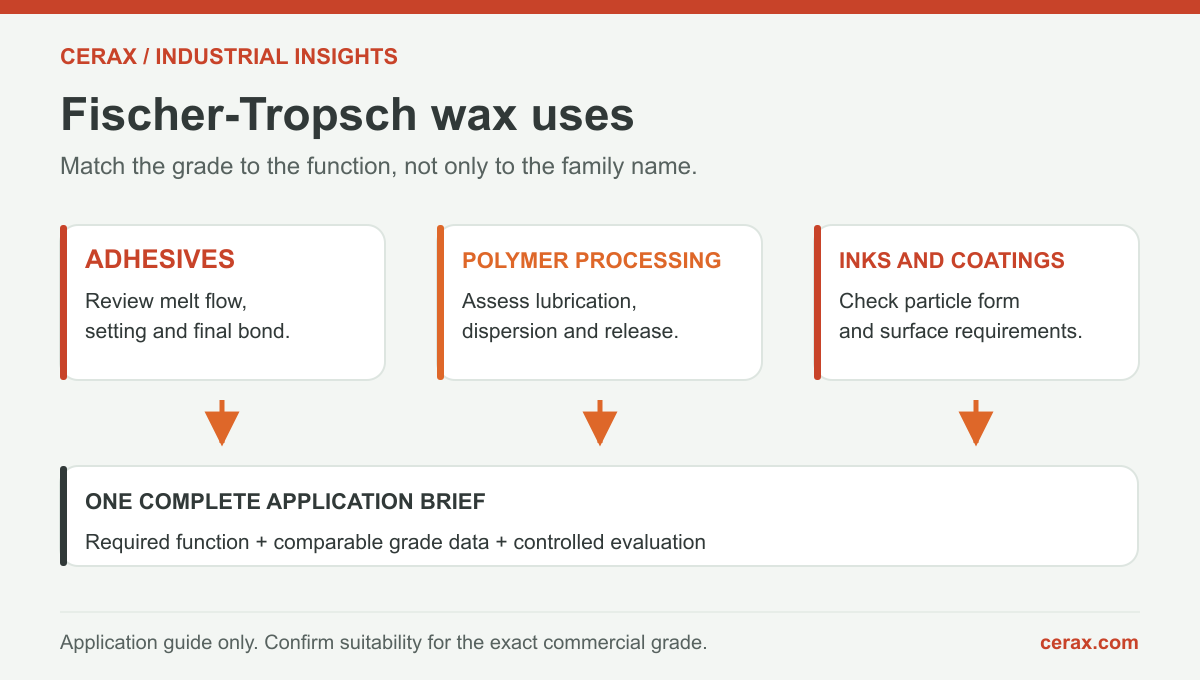
Fischer-Tropsch wax uses at a glance
The table separates common application discussions from the properties that need to be assessed. These are screening questions for a shortlist, not instructions to substitute a grade without evaluation.
| Application | Purpose of the discussion | What to compare |
|---|---|---|
| Hot-melt adhesives | Application behaviour and the finished bond | Complete adhesive flow, working time and setting |
| Polymer processing | The required processing-aid function | Resin compatibility, dispersion and downstream requirements |
| Inks and coatings | The required surface effect | Base chemistry, particle form and coating appearance |
| Polishes | A defined finish and handling requirement | Gloss, application behaviour and compatibility |
| Modified or blended systems | A function not met by one unmodified material | The exact modification and complete formulation |
1. Check the complete hot-melt adhesive
Fischer-Tropsch hard wax is an established material family in hot-melt adhesive applications. Its relevance does not mean that the wax alone determines adhesive performance. A candidate must work with the rest of the formulation and with the intended application process.
Explain whether the concern is application consistency, the time available for assembly or the finished bond. Those are connected requirements, but they are not the same test. An adhesive that becomes easier to apply can still need further assessment for bond quality or the production sequence.
Compare the candidate under the same conditions as the existing material. Keep the substrate, formulation reference and assessment criteria clear. For Cerax’s adhesive-related offering, start with specialised wax products and describe the actual task before requesting a particular grade.
2. Define the function in polymer processing
In a plastics enquiry, identify the polymer and the role required from the wax component. The discussion may concern lubrication, dispersion or release. A description such as better processing is less useful than a specific observation about the present material and the point where the issue appears.
Include the carrier, pigment or filler information relevant to the brief. Also identify any later operation that must remain acceptable, such as printing, coating or bonding. A favourable processing observation does not automatically establish that the finished article meets every requirement.
When comparing Fischer-Tropsch wax with a different synthetic material, avoid relying only on melting behaviour. Ask for comparable viscosity and other grade data where those properties matter. The technical review should connect the candidate with the whole polymer system and its intended result.
3. Distinguish chemistry from particle form in coatings
For an ink or coating, the question is often about the finished surface. Begin with the surface property required and the existing binder system. Then identify whether the proposed wax is supplied as a solid material, a micronised powder or another product form.
Micronisation describes a fine particle form, not a single chemical family. A micronised Fischer-Tropsch wax and another micronised wax can still differ in their underlying material properties. Particle-size information belongs beside chemistry and formulation compatibility in the brief.
Use the Cerax micronised wax range when that form is relevant. Include appearance and downstream requirements in the comparison so that a surface improvement is not assessed independently of the complete coating or print result.
4. Make the polish requirement specific
A polish enquiry should identify the surface, application method and finish required. Hardness or gloss may be part of the discussion, but neither describes a complete polish. The wax must work with the other ingredients and the way the finished product is used.
Keep appearance assessments consistent. If buffing or conditioning forms part of the normal use, include that context in the comparison. Record the actual candidate and reference rather than relying on a general description such as hard white wax.
Where a liquid route is being considered, the emulsions and dispersions page explains related product options. A solid FT grade and a complete polish base are different buying descriptions; ask which part of the system the proposed product supplies.
5. Decide whether a modified or blended option is needed
An unmodified material may not satisfy every part of the brief. Cerax describes functionalised synthetic options and the ability to combine materials for application-specific requirements. Those possibilities should be discussed against the property that needs to change.
State which features of the existing formulation must remain and which may be reviewed. If the task requires a different compatibility balance or a combination of properties, ask whether an established modified grade or a custom blend is the appropriate route.
Do not treat a modified product as interchangeable with its unmodified family. Confirm the exact identity, current technical and safety documents and intended use. The modification is part of the product specification, not just another name for the original wax.
Turn the application brief into a useful comparison
Before arranging a trial, agree what would count as an acceptable result. Record the reference grade, candidate identity, relevant process conditions and assessment method. If several ingredients change at once, describe that limitation when reviewing the outcome.
Keep the observations that matter to purchasing and production together. A sample result, supplied form and grade specification should refer to the same material. Where a data-sheet field is missing, request clarification rather than copying the value from an adjacent grade or a different supplier.
Fischer-Tropsch wax uses are best understood as grade-level opportunities within a complete system. Use a controlled comparison to establish what the candidate contributes and what trade-offs remain before making a routine supply decision.
An illustrative application comparison
Imagine a manufacturer assessing a Fischer-Tropsch wax candidate in an existing adhesive. The trial looks easier to apply, but the production team notices that the available assembly time no longer suits its normal sequence. The useful result is not simply improved flow. It is a recorded processing benefit alongside a timing constraint that still needs review.
The next discussion should identify which conditions were kept the same, what changed and how the bond was assessed. It should also distinguish the wax candidate from any other formulation change. If the substrate or operating sequence differed between samples, that limitation belongs in the report rather than being attributed automatically to the wax.
This is an illustrative decision example, not a Cerax customer case study. It shows why an FT-wax enquiry should connect grade data, application observations and final performance. The same approach helps an inks or plastics team report both the required improvement and any downstream effect before approving routine supply.

Frequently asked questions
Is Fischer-Tropsch wax the same as polyethylene wax?
No. Both belong to the synthetic-wax category, but they are different material families. Similar appearance or a matching temperature property is not enough to establish that one grade can replace another.
Can every FT wax be used in a hot-melt adhesive?
No. The grade must be assessed against the polymer, tackifier, application method and finished-bond requirements. An application example for the family does not approve every grade for that use.
Does micronised mean a particular wax chemistry?
No. It describes a fine particle form. Confirm the underlying wax chemistry, particle-size information and intended incorporation route for the proposed product.
What should I send Cerax with an enquiry?
Describe the application, existing material, required function and relevant specification. Include the preferred product form, trial objectives and any end-use documentation required for the exact grade.
Discuss your application with Cerax
Send the intended use, current product requirements and the result you need to achieve. Cerax can review the information needed for a relevant product and supply discussion.
Talk to the Cerax teamFurther reading: Cerax synthetic wax range · Sasol Fischer-Tropsch hard-wax overview. Application background is not a specification or approval for an individual grade.