
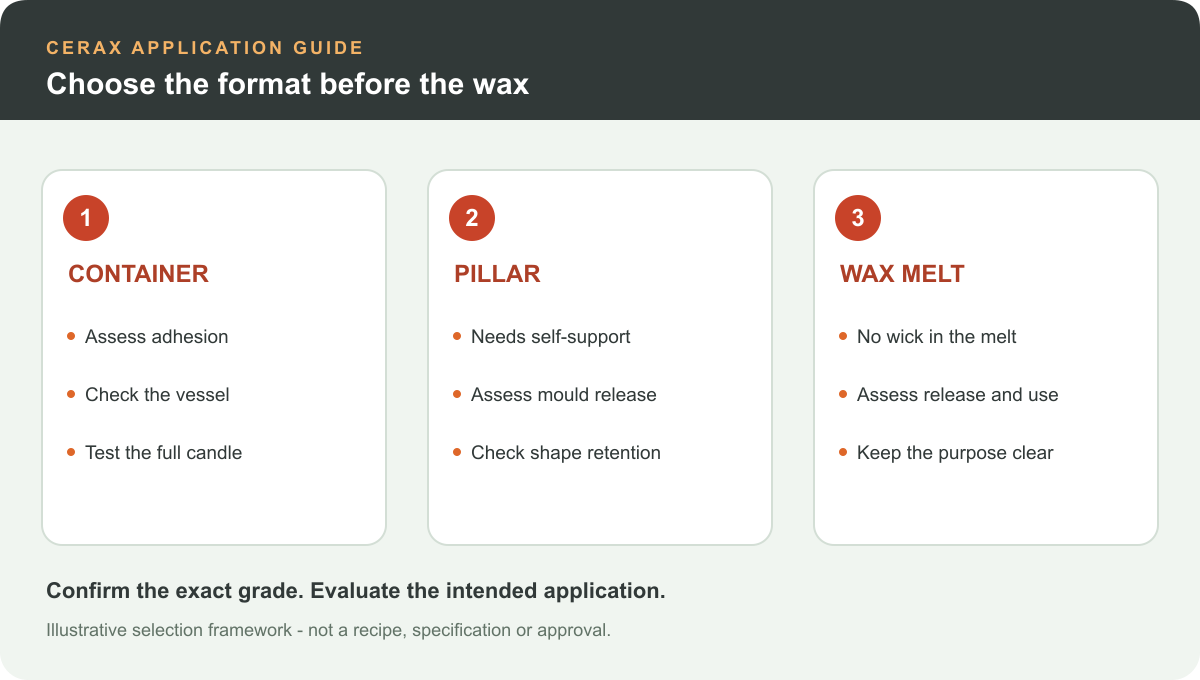
Start with the finished candle, not the wax name. A container, a freestanding pillar and a wax melt place different demands on the material. Confirm the exact grade, then assess the complete product.
Candle wax selection is easier when the enquiry describes a product rather than an ingredient alone. Two businesses can ask for paraffin yet need very different materials: one is filling a container, while the other is making a candle that must stand without a supporting vessel.
This guide is for buyers and product developers comparing candidate grades. It is not a candle-making recipe. At Cerax, a useful starting point is the intended application, the current material if there is one, and the result you need to achieve. Read the existing paraffin guide for broader grade comparisons; the checks here focus specifically on candle wax.
1. Match candle wax to the finished format
State whether you are developing a container candle, freestanding pillar, taper, tealight or wax melt. Describe the dimensions and packaging, and explain how the customer is expected to use it. A drawing or product photograph can make the requirement much clearer than a general wax-family name.
Container grades are designed for a supported product, while pillar grades must accommodate a self-supporting form and release from a mould. Wax melts have their own handling and use requirements. These distinctions do not mean that one material is better in every respect. They mean that the selection criteria need to match the product.
2. Separate candle wax origin from grade performance
Paraffin, beeswax, plant-derived waxes and blends offer different starting points. However, origin alone does not describe the behaviour of a finished formulation. Different grades within one family can vary, and a blend may be developed for a particular balance of appearance, handling and application behaviour.
If a sourcing claim matters, make it part of the written requirement. Ask which ingredients support the intended description and what evidence is available. Do not treat the words natural, premium or sustainable as substitutes for a clear material specification. Likewise, avoid assuming that a material name proves a finished candle is cleaner burning or suitable for every customer.
3. Agree the candle wax appearance to evaluate
Make appearance measurable enough for a useful comparison. Record the desired colour, surface finish, opacity and acceptable variation. For a container product, describe what acceptable contact with the vessel looks like. For a moulded product, record the expected surface and the condition after removal from the mould.
Compare samples under the same observation conditions and at agreed stages after production. Photographs should identify the batch and the observation time. A single attractive sample is helpful, but a repeatable finish across representative samples is more useful when planning routine supply. Agree which appearance differences are cosmetic and which indicate an unacceptable product.
4. Review the whole candle, not wax in isolation
The wax is one part of a product system. Wick selection, vessel design, colour and fragrance can all influence what happens in the finished candle. Changing the wax while keeping an old approval record for the complete product can leave important questions unanswered.
Use the exact grade guidance and an appropriate finished-product testing programme. Do not transfer a recommended fragrance allowance or production temperature from an unrelated wax. A number on another supplier's sheet belongs to that particular material and its stated conditions. This article deliberately gives no universal recipe, addition percentage or operating temperature.
| Finished format | Main selection question | Evidence to request |
|---|---|---|
| Container candle | Does the grade suit the chosen vessel and finish? | Grade guidance and complete-candle test record |
| Freestanding pillar | Will the finished candle retain its intended form? | Pillar suitability and mould-release evaluation |
| Wax melt | Does the material release and perform in its intended warmer? | Melt-specific suitability and product evaluation |
| Blended material | What is this particular blend designed to achieve? | Exact blend description and current grade data |
5. Compare thermal data on the same basis
Ask whether the listed temperature is a melting point, congealing point, drop point or another defined property. Include the test method with the value. A thermal figure is useful for describing a material, but it is not a complete instruction for handling, filling or using it.
If two quotations use different methods, request comparable data rather than choosing the larger number. Also distinguish a typical value from the contractual specification. The buyer should understand which properties are controlled for the grade, how a certificate of analysis is reported, and how a proposed substitute will be evaluated.
6. Include storage, packaging and repeat supply
Tell the supplier how the material will be received, stored and handled. Confirm whether the proposed form is a block, slab, flake, pellet or another format. Ask about pack size, identification, handling guidance and any storage limits stated for the grade.
For commercial production, compare the delivered requirement rather than the price per kilogram alone. A product that creates extra handling, repeated adjustment or avoidable rejects may change the practical cost of a batch. Record those observations during a representative trial; do not assume an untested candidate will save money simply because its quoted price is lower.
7. Build a clear candle wax acceptance record
Before evaluating a candidate, list the requirements that must be met and who will approve the result. Keep the grade name, batch identification, other ingredients and product format with the record. Note any difference from the current process so that the reason for a result can be investigated later.
The acceptance decision should cover the complete product and its intended use. A sample that looks acceptable at first inspection is not, on its own, a completed candle approval. Arrange the relevant performance and safety assessment with appropriately qualified people, and keep changes under review if a component or the product design changes.
An illustrative buying decision
Consider a business comparing two candidate waxes for a new jar candle. The less expensive quote gives only a family name. The other identifies a container grade and includes a current technical sheet. At this stage, neither quote proves that the finished candle will pass its requirements.
A useful next step is to obtain the missing grade information and compare representative samples using the same product design and acceptance criteria. If the business also sells pillars, it should keep that evaluation separate rather than assuming the jar result covers every format. This is an illustrative decision framework, not a Cerax customer case study or a claim about a specific grade.

What to include in your Cerax enquiry
Send the candle format, intended appearance, current grade if known, required physical form and estimated quantity. Explain whether the enquiry concerns a replacement material or a new development. Include any relevant sourcing requirement and describe the testing or approval information needed by your team.
If a previous candidate failed, describe the observation without prematurely assigning its cause. For example, an unacceptable finish is a useful starting point, but the supplier will also need to understand the product design and evaluation conditions. Clear information makes a discussion more productive than a request for the best candle wax without an application brief.
Finally, identify the person responsible for accepting a substitute. Purchasing convenience should not bypass the technical approval for the complete candle. Keep the accepted grade and product design together in the record so that the next order does not unintentionally introduce a different material.
Frequently asked questions
Can any paraffin wax be used for candles?
No. Confirm that the exact grade is intended for the relevant candle format and evaluate the finished product. A general family name is not a candle specification.
Is one candle wax best for every format?
No. Container adhesion, freestanding shape and melt release are different requirements. Choose a grade by the finished format and the evidence for that application.
Does a wax blend remove the need for testing?
No. The blend, wick, fragrance, colour and vessel can interact. A supplied blend still needs evaluation in the complete product.
Can Cerax help with a candle-wax enquiry?
Ask Cerax about available wax grades and your intended format, required quantity and performance priorities. Confirm the proposed grade and supporting documentation before ordering.
Discuss your application with Cerax
Share the intended use, current grade if known, required documents and estimated quantity. Confirm the proposed grade and application requirements before placing an order.
Talk to the Cerax teamExplore related Cerax guidance
Further reading: Cerax paraffin wax range · CandleScience: selecting wax by application. General application background is not a specification or approval for an individual grade.