



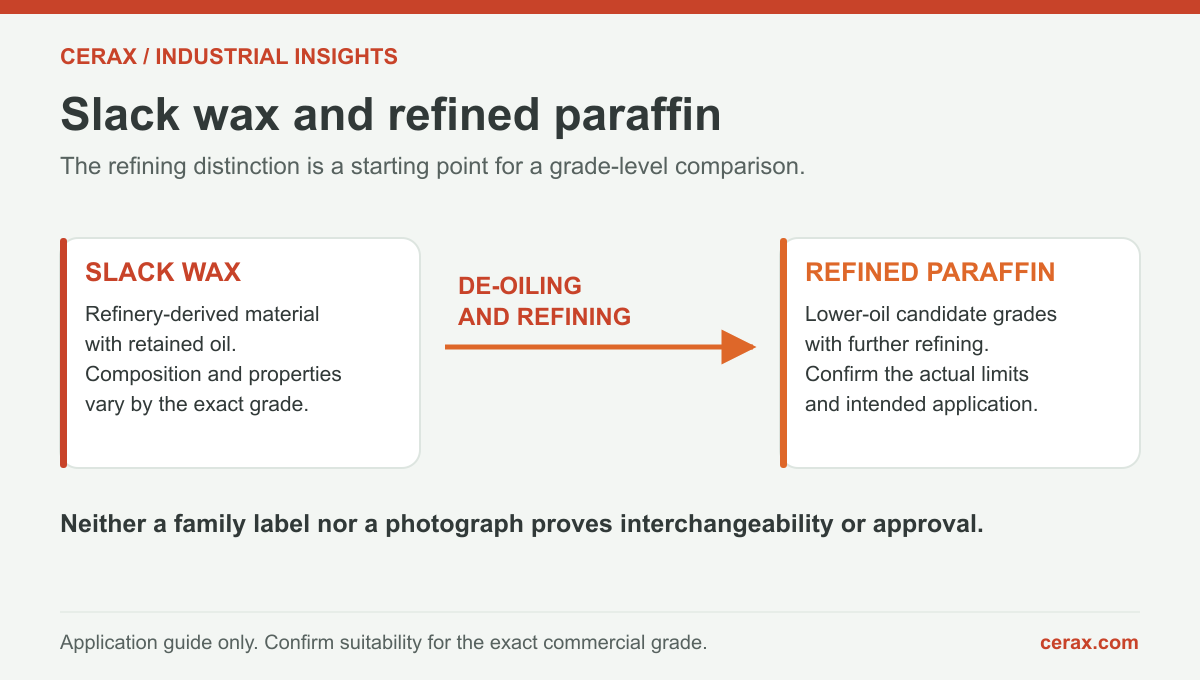
Slack and refined paraffin are related through refining, but neither name defines every product property. Compare the oil-content specification, other grade data and intended use before approving a replacement.
Slack wax versus refined paraffin is a useful comparison for an industrial buyer because the materials are related, yet their supplied grades can serve different requirements. The decision should begin with the role needed in the finished formulation, not with a general assumption that more refining is always the better choice.
This guide focuses on the distinction between retained-oil material and further-refined candidates. It complements the broader paraffin grade-selection guide by explaining six comparison points for this particular shortlist.
How slack wax and refined paraffin are related
Cerax describes slack waxes as materials obtained during refinery de-waxing, with properties that vary according to the source and grade. Further de-oiling and refining can produce semi-refined and fully refined paraffin products.
That relationship does not establish one fixed specification for each label. The catalogue distinguishes multiple slack extracts and refined grades. The product identity and technical data remain important even when two candidates sit within the same broad refining category.
Use the Cerax paraffin range to identify the relevant families, then request the current information for the exact candidates. The comparison below is a guide to the enquiry, not an approval to substitute materials without assessment.
Six comparison points at a glance
Keep these properties separate in the brief. A satisfactory value in one row does not answer every other requirement of the finished blend.
| Comparison point | Slack-wax enquiry | Refined-paraffin enquiry |
|---|---|---|
| Oil content | Request the exact retained-oil specification | Confirm the lower-oil limits for the actual grade |
| Colour and appearance | Confirm source and refining description | Check the proposed colour and applicable specification |
| Hardness and binding | Assess the needed function in the blend | Do not infer every property from refining level |
| Temperature data | Compare the same property and method | Distinguish melting, congealing and other labels |
| Intended use | Check grade-specific suitability | Refined is not blanket approval for every use |
| Supply description | Record identity, form and packaging | Ensure the quotation and sample refer to the same grade |
1. Treat oil content as an actual specification
Oil content is one of the useful distinctions between a slack wax enquiry and a refined paraffin enquiry. Ask for the figure or limit that applies to the proposed grade, together with the measurement basis. Do not treat a family description as the complete buying specification.
Oil content should be reviewed in relation to the function required in the formulation. If the present material contributes binding or flexibility, describe that role before requesting a lower-oil alternative. A change in one property may need to be assessed alongside the rest of the finished result.
For background, ASTM publishes an oil-content test method for petroleum waxes. The reference explains that oil content is a defined measurement; it does not establish that every Cerax grade has been tested or certified to that method. Confirm the method stated on the applicable documentation.
2. Confirm the source and appearance of the supplied grade
The slack wax range includes grades with different descriptions and colours. Refined candidates also have specific appearance descriptions. A photograph or a generic label such as white wax cannot establish the full identity of the product being supplied.
If colour matters to the finished formulation, include that requirement explicitly. Ask which grade-specific information or sample comparison is available. Keep the lighting and reference conditions consistent when evaluating appearance rather than using an online image as an acceptance standard.
Also check that the quotation, product sheet and sample refer to the same material. If a field is absent or a description appears inconsistent, ask for clarification instead of transferring a value from the adjacent grade in the catalogue.
3. Compare hardness, flexibility and binding requirements
Further refining is not a substitute for understanding the function of a blend component. Describe whether the requirement involves structure, flexibility, binding or another property relevant to the finished product. The exact grade must then be reviewed against that task.
Cerax’s slack range includes descriptions that distinguish paraffinic and microcrystalline character. These differences help explain why a family label alone is insufficient. If the current formulation relies on a particular binding or flexibility contribution, identify it before approving an alternative.
Where those functions are central, the microcrystalline range provides related information. It should not be assumed that a microcrystalline candidate, a slack extract and a fully refined paraffin are interchangeable simply because they can all enter wax blends.
4. Compare the same temperature property
Melting point, congealing point and softening point are different property labels. Check what the number represents and how it was measured before comparing two data sheets. A close numerical match between different labels may not describe equivalent behaviour.
Identify the temperature property used in the current specification and request comparable information for the candidate. Distinguish a typical reported value from an agreed acceptance range. If the test conditions differ, clarify that difference before ranking products.
Then assess the material in the complete formulation under relevant conditions. Temperature data can help screen a shortlist, but the finished result still depends on the other components and the intended use.
5. Keep end-use suitability tied to the grade
The refining category does not provide blanket approval for every application. Cerax describes industrial uses and grade-specific end-use examples in its range information. Those descriptions should be confirmed for the actual product and the requirement under consideration.
For an application with food-contact or other customer-specific documentation needs, state those requirements early. Request confirmation for the exact supplied grade and intended use. Do not extend a suitability statement for one material to every semi-refined or fully refined product.
This comparison is not a candle recipe, a processing instruction or a regulatory approval. It helps the buying and technical teams establish which questions must be answered before the proposed material enters an approved formulation or supply specification.
6. Compare the complete purchasing description
Record the chosen identity, supplied form, packaging and agreed properties. Keep commercial details such as quantities and delivery needs alongside the technical brief, while distinguishing them from the performance criteria. A similar trade name does not establish an approved replacement.
If a formulation needs properties that one material cannot meet, discuss wax blends or custom formulations. The next step may be a tailored combination rather than a direct swap between two refining labels.
Retain the current technical and safety documents and the trial outcome used for the decision. This gives purchasing and production a shared reference if the source material, grade or application changes later.
An illustrative replacement discussion
Imagine a buyer considering a lower-oil refined candidate for a blend that currently uses slack wax. The oil-content comparison is useful, but it does not show whether the replacement preserves the binding, flexibility or application behaviour required by that blend.
The enquiry should therefore identify the existing function and the reason for the proposed change. A controlled comparison can assess the relevant properties of the complete formulation rather than approving the substitute solely because its refining description appears more advanced.
This is an illustrative buying example, not a Cerax customer case study. It explains why slack wax versus refined paraffin is a specification and application discussion, rather than a simple ranking of family names.

Frequently asked questions
Is slack wax completely unrelated to paraffin wax?
No. Slack wax can be a starting material for further refining to produce paraffin grades. The distinction concerns the supplied material and refining level, not two automatically unrelated families.
Is fully refined paraffin always the best option?
Not for every brief. The exact formulation function, specification and intended use determine suitability. Further refining does not replace a grade-level evaluation.
Can I compare two grades by melting point alone?
No. Review oil content, hardness and other relevant properties as well. Check that the temperature numbers represent the same property measured under comparable conditions.
Does refined mean approved for any food-contact application?
No. Confirm the required documentation for the exact grade and intended use. A family name or general range statement is not universal end-use approval.
Discuss your application with Cerax
Send the intended use, current product requirements and the result you need to achieve. Cerax can review the information needed for a relevant product and supply discussion.
Talk to the Cerax teamFurther reading: Cerax paraffin wax range · ASTM oil-content test background. Application background is not a specification or approval for an individual grade.