
Separate source, grade and function. Montan is lignite-derived; raw, refined and chemically modified materials should not be treated as one interchangeable product.
Montan wax uses are best considered at grade level. The family can be relevant to polishes, processing aids and other formulated products, but a raw material, a refined grade and a chemically modified option may serve different purposes. A broad family name does not establish interchangeability.
For an industrial buyer, the useful questions are where the material comes from, what processing or modification defines the proposed grade, and which function it must perform. This guide separates those questions before moving to application assessment.
What is montan wax?
Montan wax is obtained from lignite or brown coal. Cerax includes it within the natural wax range and distinguishes dark raw material from refined grades. The source differs from palm, carnauba or sunflower materials derived from current plant production.
That distinction prevents a common purchasing misunderstanding. Natural does not automatically mean renewable, plant-derived or certified to a particular sourcing policy. If an origin requirement matters, specify it clearly and request the supporting information for the supplied grade.
Industry suppliers describe montan-based materials used in areas such as polishes and plastics processing. Those examples explain why the family may enter a formulation discussion; they do not show that every montan product is suitable for every listed application.
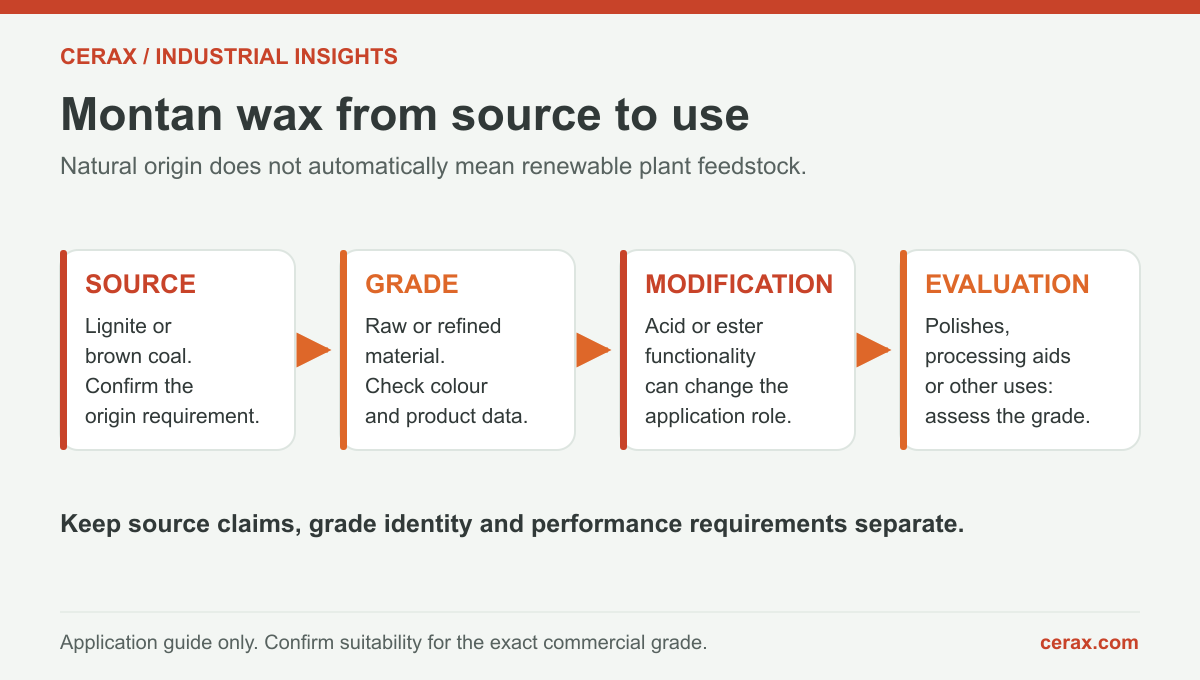
Raw, refined and modified are different buying descriptions
Use the descriptions below to frame questions for the technical team. The properties of the exact commercial grade remain the basis for a selection decision.
| Description | Useful distinction | What to confirm |
|---|---|---|
| Raw montan material | Source material before further refining | Colour, composition and relevance to the intended use |
| Refined material | Further processing changes the supplied grade | The actual properties and refining description |
| Modified montan-based wax | Chemical modification changes the product identity | The exact functionality and application role |
| Alternative wax family | A different source or chemistry | Sourcing requirements and performance in the complete formulation |
1. Make the origin requirement explicit
Begin by stating whether the project requires a particular source, renewable content or a named customer declaration. Avoid a brief that uses several labels as though they mean the same thing. A material may satisfy one origin description while not meeting a different purchasing requirement.
For montan wax, identify the lignite-derived source separately from its formulation role. If the brief specifically asks for a crop-derived material, the technical discussion may need to consider a different family rather than a differently refined montan grade.
Keep the confirmed information tied to the proposed product. Do not extend a declaration about one ingredient to a whole blend without reviewing the other components and the wording of the requirement.
2. Confirm which montan wax grade is being proposed
Ask whether the candidate is described as raw, refined, de-resined or chemically modified. These labels help establish the identity of the product under discussion. A generic request for montan wax can leave important assumptions unresolved.
Review the current technical sheet and match it to the quotation and sample name. If a description and a data field appear inconsistent, ask for clarification rather than assigning the characteristics of an adjacent product.
Also identify the required physical form and packaging. Visible blocks or flakes can help a handling discussion, but their appearance does not establish the chemistry or specification of the selected grade.
3. Define the required contribution to a polish
Cerax describes montan material in relation to shoe, floor and furniture polishes. For a polish enquiry, identify the surface, method of application and intended finish. State which part of the current result needs to change and which characteristics must remain acceptable.
Colour may be important in the complete formulation, particularly when a wax component differs visibly from the existing material. Ask for grade-specific information and compare finished samples under consistent conditions. An online picture is not a colour acceptance standard.
Where the proposal involves a liquid system or a complete base, explain that route. The emulsions and dispersions range provides related background, but a solid montan wax component and a formulated polish base are not equivalent buying descriptions.
4. Connect a processing-aid enquiry with the polymer system
For a plastics-processing discussion, identify the resin and the function required from the wax-based additive. The enquiry may concern lubrication, release or another defined processing requirement. Include relevant filler and additive constraints where they affect the comparison.
Do not assume that an acid wax, an ester-modified product and a raw montan material provide the same response. Their product identities and functions need to be reviewed against the complete system. Specify the actual limitation instead of asking only for a harder or more lubricating wax.
Keep downstream requirements in the assessment. If the finished article must be printed, coated or bonded, those operations belong in the evaluation alongside the processing observation. A gain in one stage does not automatically establish approval for the whole product.
5. Compare alternatives by function as well as source
An alternative may be considered because of performance, sourcing or a commercial requirement. Identify which reason is driving the discussion. It should not be assumed that a material from another family can replace montan wax without changing the formulation response.
For a polish application, for example, compare the required finish and application behaviour as well as hardness or temperature data. For a polymer application, define the processing-aid role and the properties that must remain acceptable in the finished article.
The wax blends range and custom formulation service offer routes for discussing a combination of requirements. Confirm the proposed scope with Cerax rather than treating a family-level alternative as a ready-approved substitute.
6. Agree the grade data and evaluation record
Request current technical and safety documents for the proposed montan wax grade. Review the property labels and test conditions so the comparison refers to equivalent information. A typical value should be distinguished from an agreed specification limit.
Set the trial objective before evaluating the sample. Keep the reference material, candidate identity, preparation conditions and assessment criteria identifiable. If another ingredient or process condition changes, record the difference when reporting the result.
Retain the outcome with the confirmed sourcing and supply information. This gives purchasing and production a common reference if the material, supplied form or intended use changes later. Missing catalogue information should be requested, not inferred from the neighbouring grade.
Before requesting samples, let the buying and formulation teams agree on the required origin description and the essential performance criteria. A shortlist based on different interpretations can lead to trials that answer the wrong question.
An illustrative shortlist decision
Imagine a project seeking the finish associated with its existing montan-based component while also introducing a requirement for a crop-derived ingredient. Refining the current material may change its grade properties, but it does not change the lignite-derived source into a current crop source.
The shortlist should therefore distinguish the source requirement from the performance requirement. A different wax family might address the first part of the brief, while the complete formulation still needs to be assessed for finish, handling and compatibility. Both questions must be resolved before a replacement is approved.
This is an illustrative buying example, not a Cerax customer case study or a claim about a particular certification. It explains why montan wax uses should be discussed alongside precise origin language and exact grade information.
Frequently asked questions
Is montan wax plant-derived?
Montan wax is obtained from lignite or brown coal. That differs from materials sourced from current plant crops such as carnauba, sunflower or palm-derived waxes.
Does natural mean renewable in this case?
No. Natural origin and renewable feedstock are different descriptions. Ask for grade-specific sourcing information if the purchasing brief requires a renewable or certified ingredient.
Can montan replace carnauba directly?
It may be considered as an alternative for some functions, but do not assume a direct replacement. Compare the exact grades in the complete formulation and check the sourcing and end-use requirements.
Are all montan waxes the same colour and performance?
No. Source, refining and chemical modification can lead to different grades. Use the exact product identity and current data rather than transferring a family description to every candidate.
Discuss your application with Cerax
Send the intended use, current product requirements and the result you need to achieve. Cerax can review the information needed for a relevant product and supply discussion.
Talk to the Cerax teamFurther reading: Cerax natural wax range · TER Chemicals montan-wax overview. Application background is not a specification or approval for an individual grade.