



Assess the complete adhesive, not the wax in isolation. Easier application, suitable assembly time and an acceptable final bond are separate requirements that must work together.
Hot melt adhesive wax is selected as part of a complete bonding system. The wax component may be relevant to flow and solidification behaviour, but a good buying decision also considers the polymer, tackifier, substrate and production sequence. A change that helps one part of the process can introduce a trade-off elsewhere.
This guide explains six checks for an industrial enquiry. It focuses on how to frame the requirement and assess a candidate, without prescribing a universal recipe, addition level or operating temperature.
What do you mean by hot melt adhesive wax?
First distinguish a wax additive from a formulated adhesive. A component contributes to a system; a complete adhesive contains the ingredients needed for its intended role. Product descriptions using the word wax can refer to different stages of that supply chain.
Cerax describes blends for hot-melt and lower-temperature adhesive-related applications within its specialised wax products. Ask which product is being offered and what further formulation work belongs to your operation. This avoids comparing an additive quotation with a complete-product quotation as though they were equivalent.
The family name also needs clarification. A Fischer-Tropsch candidate, a paraffin candidate and a tailored blend may have different properties and purposes. Review the actual grade information instead of relying on a broad description such as white wax or adhesive wax.
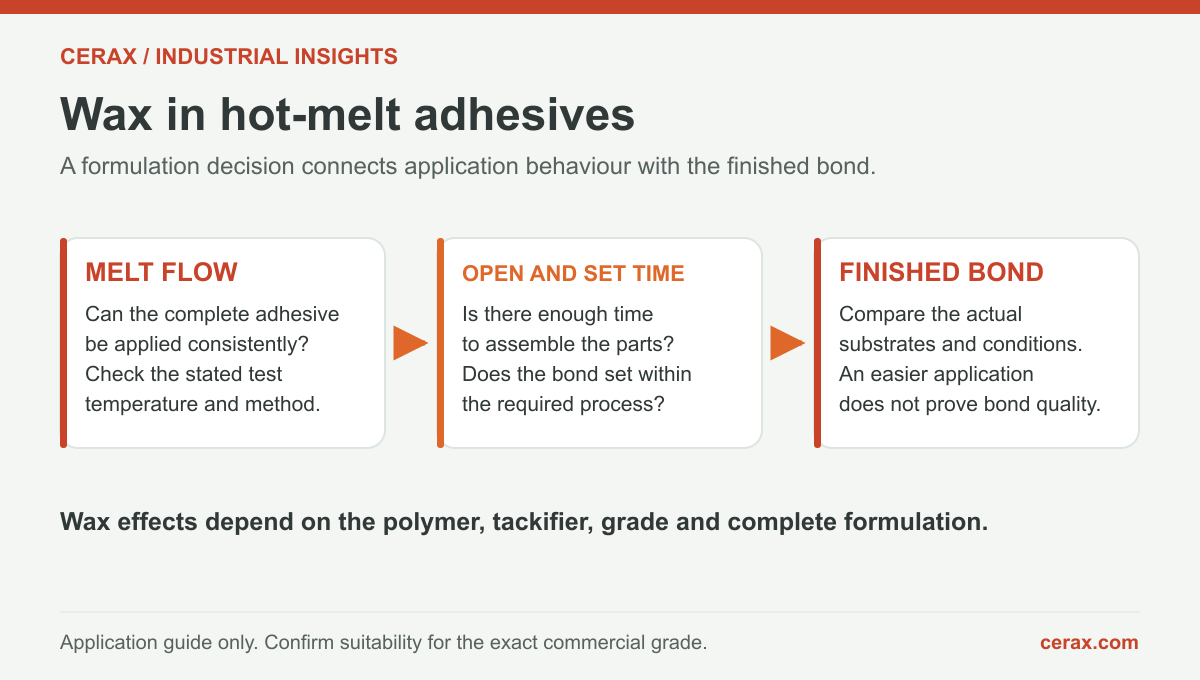
Connect flow, open time, set time and the final bond
These terms describe different questions. Keep them separate in the brief so that an improvement in application behaviour is not confused with approval of the finished bond.
| Term | Plain-language meaning | Question for the trial |
|---|---|---|
| Melt flow | Behaviour while the complete adhesive is molten | Can the adhesive be applied consistently under the intended conditions? |
| Open time | Time available to assemble the bonded parts | Does the available working time suit the process? |
| Set time | Time needed to develop the required handling strength | Can the bonded assembly proceed to its next operation? |
| Final bond | Performance after the relevant conditioning and use | Does the actual substrate combination meet the agreed criteria? |
1. Define the bonding task before choosing a wax
Identify both substrates and any surface treatment or coating that may affect the assessment. Explain the normal assembly sequence, including the time available between application and joining. State the finished-product requirements that the adhesive must meet.
If the enquiry concerns a replacement, keep an approved reference. Describe why the current material is being reviewed and which aspects of its behaviour remain acceptable. The reference gives the technical team a practical comparison instead of an open-ended request for a stronger product.
Also distinguish an application problem from a supply problem. A different product form, packaging arrangement or commercial requirement may not call for the same technical change as a bond-performance issue.
2. Compare viscosity on the same basis
Review the measurement temperature and method alongside a viscosity value. A number without its conditions can lead to a misleading comparison. The property of the wax itself should also be distinguished from the behaviour of the complete molten adhesive.
For a hot melt adhesive wax candidate, ask which data supports screening and which requirements must be assessed in the final formulation. Keep the intended application conditions identifiable when comparing the reference with the candidate.
Do not use lower as a synonym for better. The practical requirement is consistent application within the process and an acceptable bonded result. If a flow change requires a different application setting, record that difference before interpreting the outcome.
3. Assess compatibility with the rest of the formulation
The polymer and tackifier are part of the same system as the wax. Describe their relevant identities or constraints through an appropriate technical exchange. If the formula is confidential, discuss a suitable way to share information rather than putting proprietary details into a public enquiry.
When several ingredients change together, the result cannot be attributed confidently to the hot melt adhesive wax alone. Keep a clear formulation reference and record the planned changes. Where a controlled comparison is possible, use it to separate the contribution of the candidate from other adjustments.
For underlying material options, explore synthetic waxes and paraffin waxes. Those pages introduce families; they do not establish compatibility for a particular adhesive formulation.
4. Review the timing needed by the production sequence
An assembly needs enough working time to join the parts, followed by the appropriate development of handling strength. The requirement depends on the process and the product. Faster setting is not automatically useful if it removes the time the operation needs for assembly.
Define how the team will assess timing before testing the candidate. Use the intended substrates and keep the sequence consistent. Include any downstream operation that depends on when the bonded assembly can be handled.
If a candidate changes the balance, report the benefit and the limitation separately. The discussion can then address whether the formulation or the application route needs further review, rather than treating one timing observation as the whole result.
5. Evaluate the finished bond under relevant conditions
Test the actual substrate combination and the requirements applicable to the finished article. Include the specified conditioning or service conditions where relevant. A successful immediate observation may not answer a requirement assessed later in the product’s use.
Keep the agreed assessment criteria stable across the comparison. Record any substrate, surface-treatment or process difference between samples. If the result is unexpected, that record makes the next discussion more useful than a general statement that the wax did not work.
For paper and board applications, the packaging wax range provides related context. A moisture-barrier coating requirement and an adhesive-bond requirement should still be assessed as distinct functions.
6. Confirm grade documents and the supply description
Request current technical and safety documents for the exact hot melt adhesive wax candidate. Identify the proposed supplied form, packaging and required end-use information. Keep those details with the formulation and evaluation record.
If an application has food-contact or another customer-specific requirement, ask for confirmation for the exact supplied grade and intended use. A general family description is not evidence that every finished formulation meets that requirement.
Once a candidate is selected, purchasing and production should refer to the same identity and agreed description. For requirements that an established grade does not meet, discuss custom blends rather than assuming that a similar-looking wax is an approved alternative.
An illustrative trial review
Consider an adhesive candidate that appears to apply more consistently during a trial. If the assembly then has insufficient working time, the evaluation has identified a processing benefit and a timing constraint. It has not established an overall improvement that can be approved without further discussion.
The useful next step is to review the complete record: which formulation was used, which substrates were joined, what conditions were controlled and how the final bond was assessed. If a setting changed during the trial, identify it. That helps distinguish a product effect from an application adjustment.
This is an illustrative example, not a Cerax customer case study. It shows why hot melt adhesive wax selection should connect the application process with the bonded result instead of ranking candidates by one laboratory property alone.

Frequently asked questions
Is hot melt adhesive wax a complete adhesive?
Not necessarily. A wax component and a formulated adhesive are different products. Clarify whether you are buying an additive, a blend or a complete adhesive before comparing quotations.
Does lower viscosity always improve bonding?
No. A viscosity change may affect application behaviour, but bond performance must still be assessed on the intended substrates and under the relevant conditions.
Can I swap paraffin and Fischer-Tropsch grades directly?
Do not assume a direct substitution. Compare the proposed grades in the complete formulation, including compatibility, timing, application and finished-bond requirements.
Is there one correct wax addition level?
No universal level applies to every adhesive. Use the guidance for the exact candidate and establish the formulation through a qualified, controlled evaluation.
Discuss your application with Cerax
Send the intended use, current product requirements and the result you need to achieve. Cerax can review the information needed for a relevant product and supply discussion.
Talk to the Cerax teamFurther reading: Cerax specialised wax products · Sasol adhesive application overview. Application background is not a specification or approval for an individual grade.